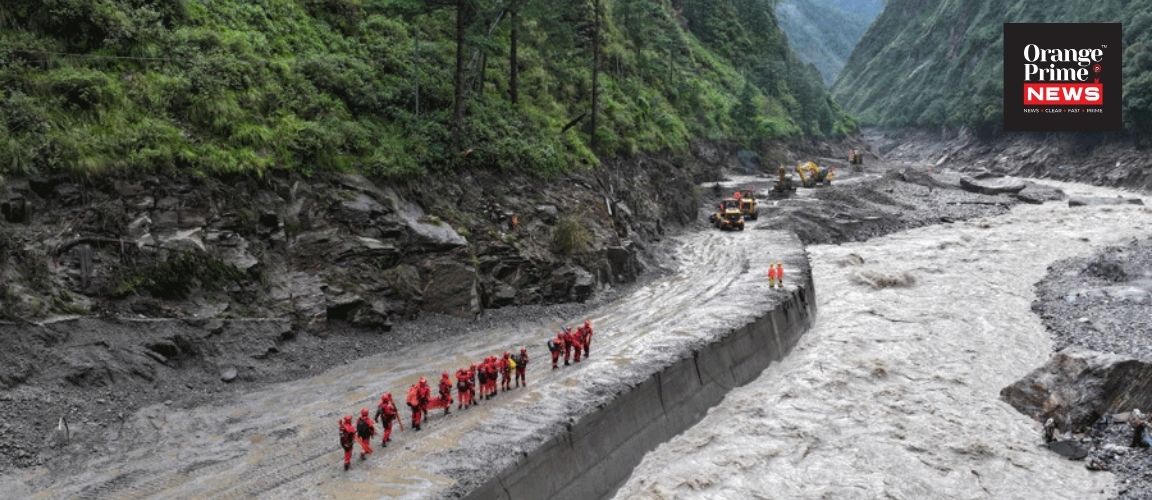
Rescue operations continued across the Nepal-Tibet border on Thursday as authorities searched for hundreds of people still missing after a catastrophic flood tore through Himalayan communities.
At least 157 bodies had been recovered by Wednesday night, according to Nepal Police, while officials said more than 400 tourists remained unaccounted for. Nepal’s tourism authorities said around 340 foreigners were believed to be among those missing.
The disaster caused widespread destruction in the mountainous region, washing away homes, roads, bridges and power infrastructure. In Tibet, a mudslide struck the Gyirong border area, disrupting roads, communications and electricity and prompting fears of a substantial number of casualties.
The scale of the destruction has complicated rescue efforts, particularly in remote mountain settlements where access has been severely restricted.
Verified video footage showed a huge torrent of water, mud and rocks racing through areas close to the border, sweeping away people, vehicles and buildings.
Survivors described scenes of extraordinary destruction as the flood moved through settlements along the river system.
Keshav Prasad Baral, a 68-year-old survivor receiving treatment at a small hospital, said he watched helplessly as mud entered his home and carried away his wife.
He said he eventually survived after being rescued by helicopter several hours later, but his wife remained buried beneath the debris.
Another survivor said he escaped by holding on to a mango tree while watching the building where he had been working disappear beneath the flood.
Glacial collapse identified as likely trigger
Early reports had suggested that an earthquake might have triggered the disaster by causing part of a glacier to collapse.
The US Geological Survey later revised that assessment.
According to the USGS, seismic energy detected during the event was generated by the collapse of glacial rock and ice and the subsequent movement of debris rather than by an earthquake.
An initial report had classified the event as a magnitude 4.4 earthquake. Further analysis of seismic information and satellite imagery indicated that the tremor-like signal was instead associated with the massive collapse.
Satellite observations also provided evidence of a landslide involving ice and rock in the Lhende River area.
Nepal’s National Disaster Risk Reduction and Management Authority said an initial analysis of Planet Labs satellite imagery indicated that the landslide triggered a debris-heavy flood around 20 kilometres northeast of the Rasuwagadhi border crossing.
The event demonstrates the dangers posed by unstable high-altitude terrain in the Himalayas, where sudden collapses can release enormous quantities of water, ice and rock into narrow valleys.
Tourist and pilgrim numbers raise concern
The large number of missing tourists has added an international dimension to the disaster.
The affected region is a popular route for trekkers and pilgrims travelling towards Kailash Mansarovar in Tibet.
The pilgrimage site is considered sacred by Hindus, Buddhists and followers of other faiths. Mount Kailash, revered by Hindus as the abode of Lord Shiva, is situated near Lake Mansarovar.
Many travellers were believed to have been passing through the region when the flood struck.
Nepal Tourism Board spokesperson Sunil Sharma said 47 missing tourists were from the United States, while 34 were Australian nationals. Thirty-three British citizens and 24 Canadians were also reported missing.
The United States said its State Department was aware of Americans affected by the floods and was monitoring developments.
Canadian Prime Minister Mark Carney said his government was closely following the situation, describing the disaster as devastating.
Australian Prime Minister Anthony Albanese also confirmed that 34 Australians were missing.
Other countries have reported citizens unaccounted for as authorities work to establish the identities and locations of people caught in the disaster.
South Korea said eight nationals working at a hydropower project were missing. Malaysia and Japan have also reported missing citizens.
Destruction spreads across Nepal
The flood caused some of its worst damage in Nepal’s Nuwakot, Dhading and Rasuwa districts.
Residents reported entire settlements being overwhelmed by water and mud.
Television footage showed homes collapsing, vehicles being carried away and bridges being destroyed by the force of the flood.
In several areas, the river rose beyond its normal course and spread across surrounding settlements.
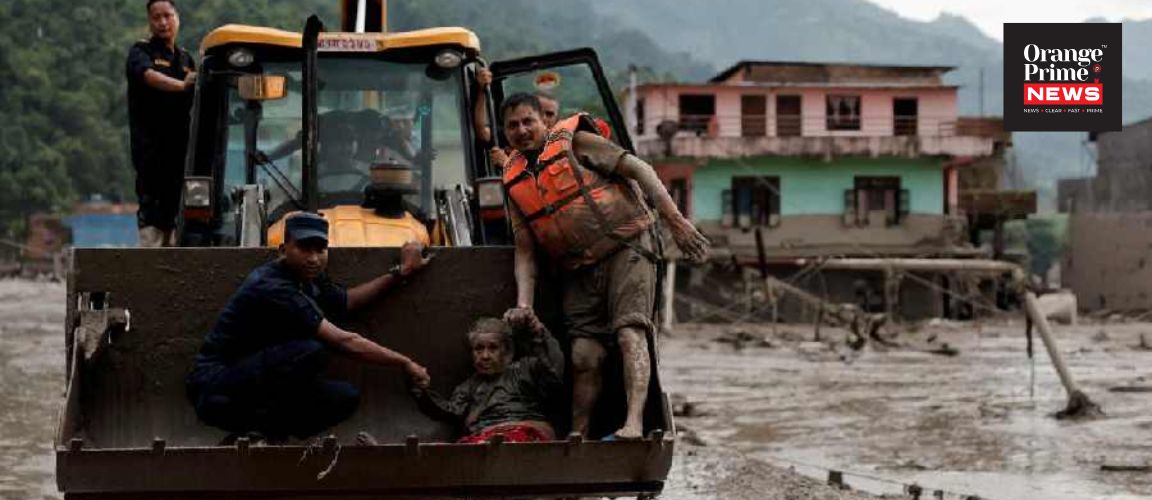
Rescue helicopters operated throughout the day, carrying survivors away from affected locations and delivering assistance where possible.
However, rescue operations were hampered by the terrain and the extent of infrastructure damage.
Helicopters were unable to land in some locations, including Syapru Besi and Timure in Rasuwa district.
The district, which has a population of roughly 50,000, contains several communities that were badly affected by the flooding.
With roads and bridges damaged, emergency teams have been forced to rely heavily on helicopters and other specialised equipment.
Families search for missing relatives
The human impact of the disaster was evident around a Nepal Army training centre that was being used as a base for helicopter rescue operations.
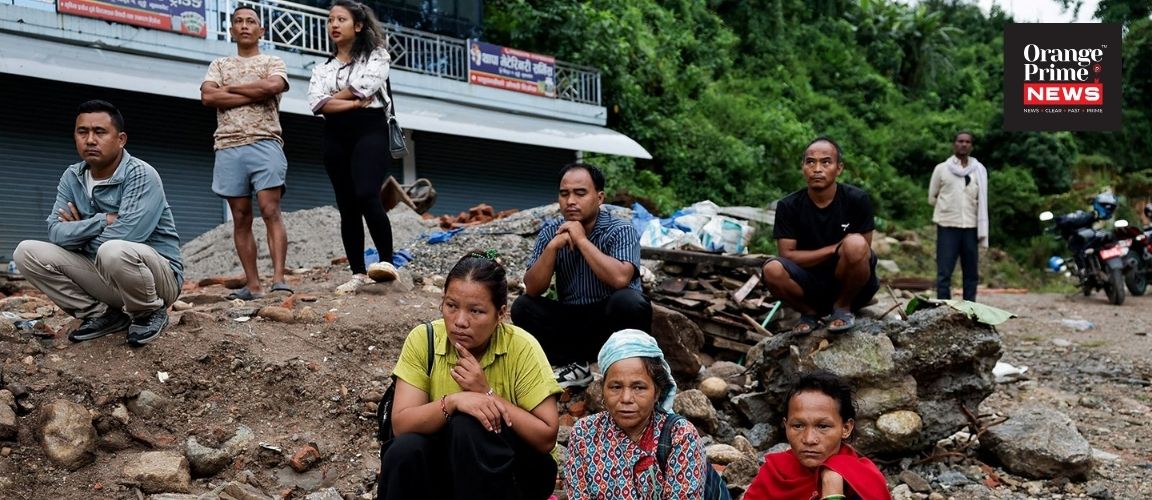
Residents from Nuwakot and Dhading gathered outside the facility seeking information about relatives who had disappeared.
Police officers recorded the names and details of missing people near the barracks.
The area remained without electricity after hydropower infrastructure was damaged, forcing officials and residents to rely on mobile phone flashlights while compiling information.
The process of identifying missing people is expected to take time.
Some individuals may have survived but remain cut off from their families because communications networks have been damaged.
Others may have been swept downstream or become trapped beneath mud and debris.
Authorities therefore face the difficult task of separating temporary communication failures from confirmed disappearances.
Tibet border crossing severely damaged
The disaster also caused major disruption on the Chinese side of the border.
China’s official Xinhua news agency reported that a mudslide struck the Gyirong port in the Tibet region.
Roads, power supplies and communications were damaged, leaving the border crossing effectively cut off.
Chinese state broadcaster CCTV reported that three people had been killed and 265 were missing in Gyirong, although officials stressed that the figures were still being verified.
A rescuer told CCTV that efforts to contact the border port had not produced results.
A preliminary drone assessment indicated that roads leading to the crossing had been completely destroyed.
The flood and mudslide therefore affected an important border route as well as nearby communities.
The damage to transport and communications infrastructure is likely to make it harder for rescue workers to reach isolated areas and determine the full extent of casualties.
India issues flood alerts
The disaster also triggered concern downstream in India.
The huge volume of water moving through the river system prompted flood alerts in Bihar and Uttar Pradesh, two densely populated states that share a border with Nepal.
Several rivers flowing from the Himalayan region enter the Indian plains, creating a potential risk for communities downstream.
Authorities in Bihar began evacuating residents from vulnerable areas.
Officials said around 5,000 people had been moved from six districts, while plans were being prepared to evacuate between 10,000 and 12,000 people if conditions deteriorated.
The situation is being monitored closely because further rainfall could increase river levels and complicate the movement of floodwater into the plains.
The cross-border nature of the river system means developments in Nepal can have immediate consequences for communities in northern India.
United Nations and foreign governments respond
The international community has begun responding to the disaster as the number of missing people continues to rise.
The United Nations said its teams and partners were mobilising personnel and supplies to assist communities affected by the floods.
Governments whose nationals are believed to be missing have also begun working with Nepalese authorities to gather information.
The priority for foreign missions is to establish contact with citizens in the affected region and determine whether they require evacuation, medical treatment or other assistance.
The response is complicated by damaged communications and the destruction of roads leading into several affected locations.
For Nepal, the immediate challenge is to coordinate large-scale rescue operations across multiple districts while simultaneously providing shelter and assistance to displaced communities.
Rescue efforts continue amid uncertainty
Emergency workers are facing difficult conditions as they attempt to reach areas buried beneath mud and debris.
The destruction of bridges and roads has left some settlements isolated.
Helicopters remain essential for reaching communities where ground access is impossible.
At the same time, officials are continuing to collect information from residents, tourists, hotels, pilgrimage operators and border authorities to build a clearer picture of those missing.
The casualty figures are therefore expected to change as rescue teams reach previously inaccessible areas.
Authorities have warned that the final toll could be significantly higher than current confirmed figures.
The disaster has also highlighted the vulnerability of Himalayan communities to sudden geological and glacial events.
The combination of high-altitude ice, unstable slopes, heavy monsoon conditions and narrow river valleys can create extremely destructive flood waves with little warning.
A regional humanitarian emergency
The Nepal-Tibet disaster has rapidly developed into a humanitarian emergency extending beyond a single country.
At least 157 people have died, hundreds of tourists remain missing and large numbers of families have been displaced.
Nepal is confronting extensive damage to homes, transport links and critical infrastructure, while Tibet is dealing with destruction around the Gyirong border area.
The disappearance of hundreds of foreign tourists and pilgrims has added urgency to the international rescue effort.
At the same time, downstream risks have prompted Indian authorities to prepare for possible flooding in Bihar and Uttar Pradesh.
The immediate priority remains finding survivors and accounting for missing people.
As rescue teams gain access to more areas, authorities are likely to revise casualty figures and provide clearer information about the scale of the destruction.
The disaster’s likely connection to a glacial collapse rather than an earthquake has also raised fresh questions about the risks posed by rapidly changing Himalayan environments.
For now, rescue workers continue to confront mud, damaged infrastructure and difficult terrain as they search for survivors and missing people across one of the region’s worst recent natural disasters.