India-New Zealand ties enter a strategic phase
India and New Zealand have formally upgraded their relationship by launching a Strategic Partnership designed to strengthen cooperation across multiple sectors over the next several years.
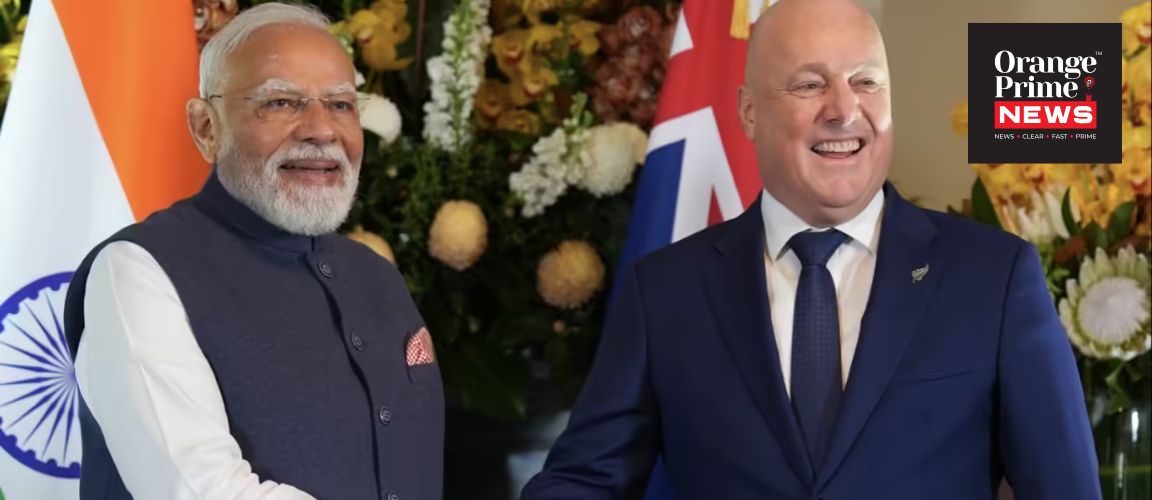
The agreement was finalised after talks between Prime Minister Narendra Modi and New Zealand Prime Minister Christopher Luxon in Auckland, where both leaders described the partnership as a natural progression of growing political, economic and strategic engagement.
The newly adopted Roadmap to 2030 serves as the guiding framework for future collaboration. Although it does not impose legally binding obligations, it lays out priorities for regular political dialogue, defence cooperation, trade expansion, innovation, education, regional security and multilateral engagement.
The announcement came during Modi's first official visit to New Zealand, ending a four-decade gap since the last visit by an Indian Prime Minister.
Trade target set at NZ$7 billion by 2030
Economic cooperation emerged as the centrepiece of the discussions.
Both governments committed themselves to raising bilateral trade in goods and services to NZ$7 billion by 2030, almost doubling current trade levels.
Prime Minister Modi noted that commercial exchanges between the two countries have already grown significantly during the past three years and expressed confidence that the recently concluded Free Trade Agreement (FTA) would accelerate that momentum.
The agreement, signed earlier this year, is currently moving through implementation procedures before coming into force.
Officials expect the FTA to create greater opportunities for exporters, manufacturers, agricultural producers and service providers in both countries.
The roadmap also identifies agriculture, horticulture, dairy, forestry, food processing and animal husbandry as priority sectors for deeper collaboration through joint research, innovation, technical cooperation and market development.
Security cooperation to expand significantly
Apart from economic ties, security cooperation featured prominently in the discussions.
India and New Zealand agreed to establish a Joint Working Group on Counter-Terrorism that will facilitate intelligence sharing, policy coordination and cooperation between security agencies.
The two governments reaffirmed their commitment to combating terrorism in all forms, including cross-border terrorism, and called for stronger international efforts to dismantle terror financing networks and bring perpetrators to justice.
The roadmap also encourages closer cooperation through international forums such as the United Nations and the Financial Action Task Force (FATF).
In addition, both countries are expected to strengthen law enforcement coordination and explore agreements to tackle organised crime and narcotics trafficking.
Defence partnership gains fresh momentum
The Strategic Partnership also outlines plans for broader defence engagement.
India and New Zealand will expand military cooperation through:
Joint military exercises
Naval and air force visits
Defence personnel exchanges
Collaboration between military training institutions
Regular defence ministry consultations
The two sides also agreed to hold an annual Maritime Security Dialogue under the Indo-Pacific Oceans Initiative.
Cybersecurity cooperation and defence technology exchanges are expected to become important pillars of the evolving relationship.
Both governments reiterated their support for maintaining a free, open, peaceful and rules-based Indo-Pacific where international law, sovereignty and freedom of navigation are respected.
Shared Indo-Pacific vision
Regional security formed another major component of the Auckland discussions.
India and New Zealand emphasised the importance of strengthening cooperation in maintaining peace and stability across the Indo-Pacific region.
The roadmap calls for closer coordination on maritime security, resilient supply chains and regional institutions.
Both leaders stressed that disputes in the Indo-Pacific should be resolved peacefully through dialogue and in accordance with international law.
The partnership also aims to strengthen cooperation in regional groupings and multilateral institutions dealing with economic security, disaster resilience and sustainable development.
New Zealand reiterates support for India's UNSC bid
A significant diplomatic outcome of the summit was New Zealand's renewed backing for India's bid for permanent membership of a reformed United Nations Security Council.
Both countries agreed that global institutions should evolve to reflect present-day geopolitical realities.
The leaders also expressed support for expanding both permanent and non-permanent membership of the Security Council as part of wider UN reforms.
The roadmap further encourages closer coordination on international issues including nuclear non-proliferation, sustainable development and global governance reforms.
Greater connectivity through flights and digital payments
Improving physical and digital connectivity is another important objective under the new partnership.
The roadmap proposes exploring direct non-stop flights between India and New Zealand to facilitate tourism, business travel and educational exchanges.
Officials also plan to strengthen cooperation in aviation under an updated air services framework.
On the digital front, both governments are working towards integrating India's Unified Payments Interface (UPI) with New Zealand's payment ecosystem.
Such connectivity could make transactions easier for tourists, students, businesses and members of the Indian diaspora living in New Zealand.
Education, research and technology collaboration
Education remains one of the strongest links between the two countries, and both governments have agreed to deepen institutional partnerships.
Universities and research organisations are expected to collaborate more closely through joint projects, academic exchanges and innovation programmes.
The roadmap also highlights cooperation in:
Artificial intelligence
Digital technologies
Renewable energy
Climate change research
Sustainable development
Advanced manufacturing
Scientific innovation
These initiatives are intended to encourage knowledge-sharing while supporting economic growth and technological advancement.
Disaster management and climate resilience
Recognising the increasing impact of climate-related disasters, India and New Zealand also agreed to strengthen collaboration in disaster preparedness and emergency response.
Their respective disaster management agencies will cooperate on capacity-building, training programmes, emergency planning and resilience measures.
The roadmap encourages exchanges of expertise in disaster risk reduction, early warning systems and humanitarian response mechanisms.
Sports and cultural exchanges receive attention
Beyond strategic and economic cooperation, the agreement also places emphasis on strengthening cultural and sporting ties.
The two countries adopted a joint sports action plan that covers coaching, sports science, athlete development, youth participation and women's sports.
Officials also hope to encourage greater tourism, cultural exchanges and cooperation between local governments.
Traditional medicine and heritage exchanges have also been identified as areas for future collaboration.
Indian diaspora recognised as a bridge
Both Prime Ministers acknowledged the growing contribution of the Indian community in New Zealand.
The diaspora continues to play an important role in education, healthcare, technology, entrepreneurship and cultural exchange.
Prime Minister Luxon described Indian New Zealanders as an important bridge connecting the two countries and strengthening mutual understanding.
Their contribution is expected to become even more significant as bilateral business and educational links continue expanding.
Leaders express optimism for future cooperation
Prime Minister Modi described India and New Zealand as "natural partners" united by democratic values, maritime interests and shared aspirations for peace and prosperity.
He said the Strategic Partnership provides a structured roadmap that will help translate shared values into practical cooperation across multiple sectors.
Prime Minister Luxon also expressed confidence that the agreement would deepen collaboration in trade, security, innovation and people-to-people ties.
He highlighted India's rapid economic transformation and encouraged New Zealand businesses to explore opportunities in one of the world's fastest-growing major economies.
With a comprehensive roadmap now in place until 2030, both countries expect the partnership to become broader, deeper and more strategically significant in the years ahead.