Teenager’s injuries raise questions over police conduct
The case of Eden, a 14-year-old whose surname has been withheld at his family’s request, has become a focal point in the growing controversy over French police responses to student demonstrations.
According to his parents and family lawyer Elsa Marcel, Eden sustained a fractured jaw and suffered multiple broken teeth after being struck in the face by a tear gas projectile during a protest in Saint-Ouen-l’Aumône last week.
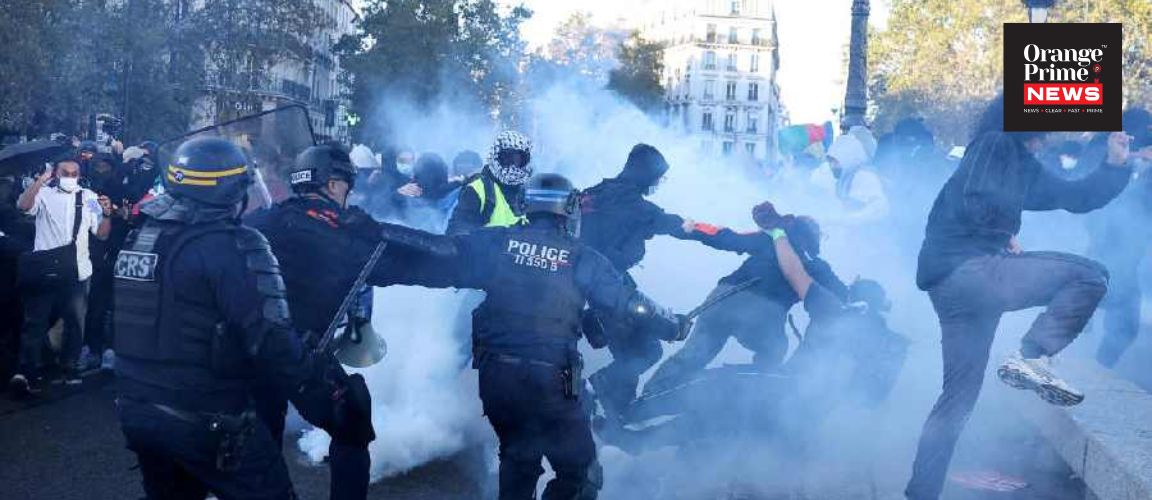
The lawyer told Reuters that the teenager had been sitting on a wall, looking at his phone, a short distance from the demonstration when the confrontation occurred. According to the account provided by the local prosecutor, an officer approached Eden and struck him with a baton. The teenager allegedly responded by kicking the officer.
A second police officer then fired a tear gas grenade using a Cougar launcher, hitting Eden in the face, according to the account described in the report.
Marcel alleged that the officer shot the teenager in the mouth and left him on the ground without calling emergency services. Eden’s family has filed a complaint accusing the officer of attempted murder, the lawyer said.
The police have declined to comment on the ongoing investigation. According to the prosecutor’s office, the officer involved said he had been trying to protect himself and his colleagues after the teenager confronted the police.
The officer was placed under formal investigation on Tuesday on suspicion of assault by a public official resulting in permanent disability or disfigurement. The development came eight days after the incident.
The investigation will be important in establishing the sequence of events, the circumstances in which the projectile was fired and whether the force used was lawful and proportionate. The allegations have not, at this stage, been established as proven findings.
One of 24 investigations into protest policing
Eden’s case forms part of a wider examination of police conduct during more than two weeks of student unrest across France.
The country’s internal police watchdog, known as the IGPN, is investigating 24 cases connected to the policing of the demonstrations. The unrest began amid dissatisfaction with conditions in schools and has developed into a broader confrontation involving students, law enforcement and political leaders.
Prime Minister Sébastien Lecornu has described the demonstrations as the most violent in decades, reflecting the seriousness with which the government views the disruption.
Reuters said it had documented 28 cases of injuries linked to police force through interviews and examination of legal documents. Fifteen of those cases were among the incidents being investigated by the IGPN.
The reported injuries involved several types of police equipment and tactics, including rubber bullets, stun grenades, tear gas, batons and charges by officers on horseback.
The number and severity of the reported injuries have intensified scrutiny of the methods used to control crowds, particularly when teenagers are involved.
Injuries to young protesters intensify public concern
Eden’s injuries are not the only case to have triggered alarm during the unrest.
In Lens, a 15-year-old student lost a hand in an incident believed to have involved a stun grenade. Interior Minister Laurent Nuñez said the injury was likely caused by such a device and announced a pause in the use of stun grenades while the circumstances were investigated.
Two other cases documented in the Reuters report involved people who suffered eye injuries or lost an eye after being struck by rubber bullets.
Another incident occurred in Argenteuil, a suburb of Paris, where a 16-year-old student was injured in his left eye while returning home after discovering that his school was closed.
The student’s lawyer, Sophia Kerbaa, told Reuters that it was not clear whether the injury had been caused by a rubber bullet or another object. A video reviewed by the news agency showed the teenager bleeding from the eye.
Kerbaa said the boy had been in the wrong place at the wrong time and was left injured and traumatised.
However, the prosecutor investigating the incident cited the police account that the teenager appeared to match one of two young people suspected of directing fireworks towards officers. Police reportedly responded by firing rubber bullets.
The precise circumstances surrounding the incident remain unclear, and the competing accounts underline the need for investigations to establish what happened.
Government acknowledges injuries as authorities report widespread violence
The French government has also pointed to injuries among police officers and damage caused during the demonstrations.
Nuñez said in a radio interview on Wednesday that approximately 200 students had been injured, while maintaining that police action was responsible for only a small proportion of those injuries.
He said protecting high school students remained a primary responsibility of the authorities.
Officials have also reported that around 700 police officers were injured during the unrest. Schools have reportedly been burned or ransacked, while teachers and members of the public have faced attacks.
Authorities said police had arrested 6,877 people, most of them minors.
The figures illustrate the scale of the disorder and the competing concerns confronting the government. While officials are under pressure to restore order and protect public institutions, allegations of excessive force have raised questions about how officers should respond when demonstrations become violent.
The distinction between maintaining public safety and using disproportionate force is central to the debate. Rights advocates argue that the severity of injuries suffered by some young people demands a reassessment of the weapons available to officers.
Researchers say France stands apart in its use of crowd-control weapons
Sebastian Roche, a researcher specialising in policing at the French National Centre for Scientific Research, said the number and seriousness of injuries during the unrest were exceptional.
He pointed to four irreversible injuries involving minors within a 12-day period, describing the situation as unprecedented in contemporary French history.
Roche also argued that France stands out among European countries for its use of so-called less-lethal weapons, including rubber bullets and stun grenades, during public-order operations.
According to his assessment, these weapons are generally not used for public-order policing in Britain, Italy and Germany, apart from limited exceptions such as Hamburg. Spain permits some of these weapons, but Roche said the resulting injuries have been fewer than in France.
The term “less-lethal” refers to weapons designed to reduce the likelihood of death compared with conventional firearms. However, such devices can still cause severe or permanent harm, particularly when fired at close range or when they strike vulnerable parts of the body.
The cases reported during the demonstrations have renewed debate over whether the risks associated with these weapons are compatible with their use in crowds that include minors.
Human rights advocates demand restrictions
Human rights organisations, including Amnesty International, and several politicians have called for the permanent withdrawal of certain crowd-control weapons.
Their position is that the possibility of life-changing injuries requires authorities to reconsider whether rubber bullets and grenade launchers should be used during public-order operations, particularly against student demonstrators.
Bally Bagayoko, mayor of Saint-Denis and a member of the left-wing France Unbowed party, joined protests in his town and called for rubber bullets to be withdrawn.
Bagayoko argued that eliminating their use could help reduce injuries and lower tensions between police and young people. His position reflects a wider call for de-escalation, with protesters and their supporters arguing that safer policing methods should be prioritised.
The controversy also comes amid wider dissatisfaction with President Emmanuel Macron’s government ahead of the 2027 election. For some demonstrators and their supporters, the treatment of students has become another symbol of deeper political and social grievances.
However, calls for a permanent ban remain contested, with police representatives warning that removing certain weapons could leave officers with fewer options when confronted by violent crowds.
Police unions defend the need for intermediate force options
Police unions have resisted arguments that the injuries should lead to a fundamental change in French crowd-control practices.
Thierry Clair, a representative of a police union, described severe injuries such as Eden’s and the loss of a teenager’s hand as tragedies. Nevertheless, he argued that such cases should not automatically invalidate the policing methods used by officers.
Clair attributed the problem instead to the intensity of violence committed by some young people during confrontations with police.
He warned that removing intermediate force options could leave officers with a choice between allowing dangerous situations to continue and resorting to lethal force.
The argument highlights the central disagreement in the debate. Supporters of current policing methods say officers require equipment capable of responding to violent situations while avoiding firearms. Critics counter that the documented injuries show that weapons categorised as less-lethal can still produce devastating consequences.
The challenge for French authorities is to determine whether existing safeguards, training and rules governing the use of such equipment adequately protect both protesters and police officers.
What happens next?
The investigations into the reported injuries will be closely watched as France seeks to manage the continuing fallout from the student demonstrations.
In Eden’s case, investigators will need to examine the circumstances leading to the confrontation, the officer’s justification for using the launcher and the sequence of events after the teenager was injured. The other investigations may also help establish whether the reported injuries resulted from individual decisions or wider shortcomings in crowd-control practices.
The temporary suspension of stun grenade use following the Lens incident signals that authorities are prepared to review at least some aspects of police equipment deployment while investigations continue.
However, broader demands for a permanent ban on rubber bullets and grenade launchers are likely to remain a contentious issue between rights groups, politicians and police unions.
For the families of injured students, the immediate concern is accountability and recovery. For the government, the challenge is to restore order without undermining public confidence in law enforcement.
The outcome of the investigations could shape the next phase of France’s debate over protest policing, the protection of minors and the limits of force during demonstrations.