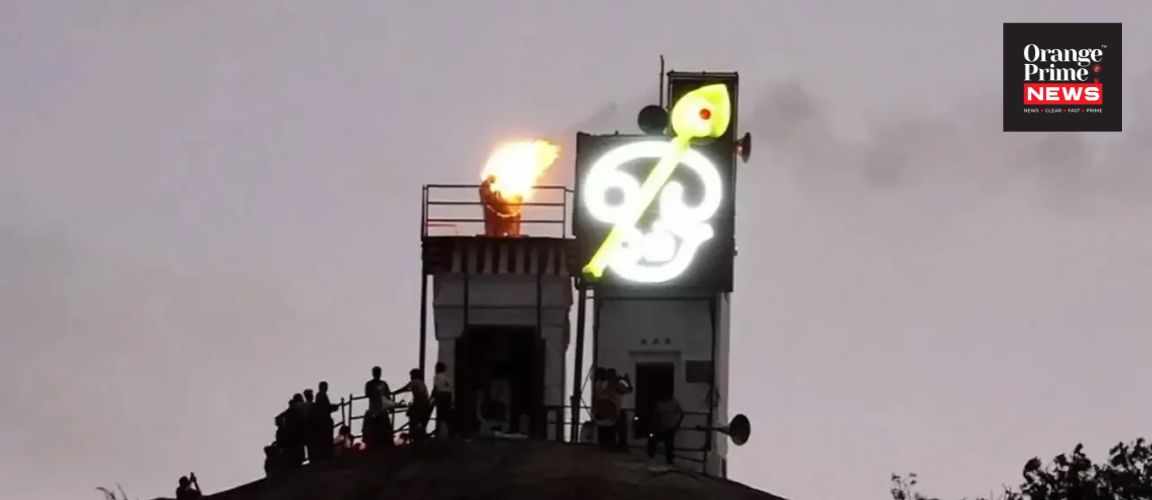
Karthigai Deepam lit at traditional location
The ceremonial lamp was lit at Uchipillayar Mandapam, the traditional site near the foothills of Thirupparankundram, at the auspicious time of 6pm on Tuesday.
The TVK government maintained its position despite demands from the BJP and several Hindu organisations that the ritual be conducted at the Deepathoon, a stone pillar situated near a dargah on top of Thirupparankundram hill.
The controversy unfolded under heavy police deployment, with authorities restricting public movement around the hill and prohibiting gatherings and processions in parts of Madurai.
The lighting of the lamp at the traditional location brought the immediate uncertainty over the ceremony to an end, but protests continued after the ritual.
Madras High Court questions district-wide prohibitory orders
The dispute reached the Madurai bench of the Madras High Court on Tuesday, with several petitions challenging prohibitory orders issued by district collector Nishant Krishna under Section 163 of the Bharatiya Nagarik Suraksha Sanhita (BNSS).
A division bench comprising Justice G.R. Swaminathan and Justice M.D. Sumathi heard the petitions shortly before the scheduled lighting of the lamp.
The judges observed that restrictions imposed across the entire district could interfere with devotees' constitutional right to practise and profess religion under Article 25.
The bench asked the district administration to reconsider its order, noting that the restrictions could affect the implementation of the Supreme Court's interim direction concerning the lighting of the ceremonial lamp.
The court also made clear that the Tamil Nadu government's pending review petition against the Supreme Court's November 20 order could not be treated as a reason for failing to comply with the existing direction.
Justice Swaminathan said the court was seeking to ensure that the lamp was lit at the top of the hillock, referring to the location specified in the Supreme Court's order.
Supreme Court had permitted one-time lighting at Deepathoon
The controversy centres on an interim order issued by the Supreme Court on November 20.
The top court had permitted the ceremonial lamp to be lit at the Deepathoon, a stone pillar near a dargah atop Thirupparankundram hill. The permission was described as a strictly one-time arrangement.
The Uchipillayar Mandapam, where the ritual was eventually conducted, is situated below the hill, close to its foothills.
The BJP and several Hindu organisations have argued that the lamp should be lit at the Deepathoon in accordance with the Supreme Court's direction. Their demand became the focus of protests and political mobilisation ahead of Tuesday's ceremony.
The state government, however, defended the restrictions imposed by the district administration and maintained that its priority was to prevent unauthorised movement up the hill and preserve law and order.
Government defends restrictions, 258 people detained
Representing the Madurai district collector, the government's counsel told the High Court that the prohibitory order had been issued to prevent unauthorised individuals from climbing the hill.
The counsel argued that the collector had acted in accordance with the Supreme Court's direction and had taken steps to maintain peace during the festival.
The court was also informed that the restrictions were directed at individuals associated with certain organisations. Around 258 people had been detained, according to the submission made before the bench.
The administration's position was that it remained accountable to the Supreme Court regarding implementation of the interim order.
However, the High Court questioned the breadth of the restrictions and their possible impact on religious freedoms.
BJP leaders stopped from reaching Madurai
The security arrangements also affected several senior BJP leaders who intended to visit Madurai and demand that the lamp be lit at the Deepathoon.
Tamil Nadu BJP president Nainar Nagendran was reportedly detained at his residence in Tirunelveli before his planned journey to Madurai.
Former state BJP president L. Murugan's vehicle was stopped while he was travelling from Coimbatore, and he was sent back. Another former state president, Tamilisai Soundararajan, was detained after arriving at Madurai airport.
The restrictions were part of a wider security operation around Thirupparankundram. Police declared the surrounding area a red zone and prohibited drone operations from Monday evening.
Public gatherings and processions were also barred in parts of Madurai following intelligence inputs suggesting that large numbers of people could assemble to demand the lighting of the lamp at the disputed location.
Devotees were not allowed to climb the hill. However, the traditional chariot-pulling ceremony around the Thirupparankundram Subramanya Swamy temple at the foothills took place.
Heavy security deployment and protests after the ritual
More than 5,600 police personnel were deployed near the temple to manage the situation.
After the lamp was lit at Uchipillayar Mandapam, hundreds of volunteers associated with Hindu organisations staged a sit-in protest near the foothills. They objected to the decision not to conduct the ceremony at the Deepathoon.
Police personnel struggled to disperse the demonstrators and moved several protesters away in vehicles.
The incident highlighted the continuing tension between the competing demands over the ritual's location and the administration's efforts to prevent a confrontation.
Karti Chidambaram backs TVK government's position
Congress MP from Sivaganga Karti P. Chidambaram defended the TVK government's decision to seek a review of the Supreme Court's interim order.
His party is part of the TVK-led coalition in Tamil Nadu.
Chidambaram argued that religious practices were increasingly being given a political dimension. He said lighting lamps during Karthigai Deepam was a customary practice in Tamil Nadu's temples and homes, but the issue had acquired a political character.
He maintained that longstanding rituals in the state had not been stopped and supported the government's decision to challenge the interim order through a review petition.
The dispute has therefore extended beyond the immediate arrangements for the festival, bringing together questions of religious practice, judicial directions, public order and political mobilisation. Although the lamp was lit at the traditional location, the disagreement over the Deepathoon and the implementation of the Supreme Court's order remains unresolved.