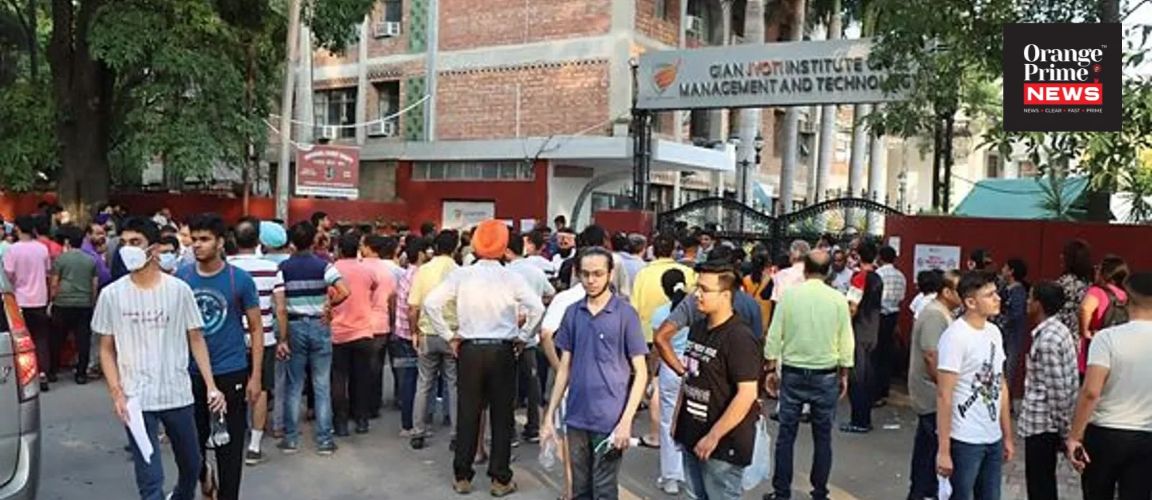
On-screen calculator facility introduced for JEE Advanced 2027
The Indian Institutes of Technology (IITs) have decided to introduce an on-screen calculator facility for candidates appearing in JEE Advanced 2027.
IIT Delhi, the organising institute for next year's examination, confirmed the decision in a media release on Friday, November 13.
According to the announcement, candidates will be provided with a basic, non-scientific calculator featuring a display of 10 to 12 digits.
"Candidates appearing for JEE (Advanced) 2027 will have the provision of using an on-screen basic (non-scientific) calculator with a 10-12 digit display," IIT Delhi stated.
Although JEE Advanced has been conducted in computer-based test (CBT) mode, candidates were previously not permitted to use an on-screen calculator. The new provision will therefore introduce a significant change to the examination process.
Calculator expected to help candidates manage time
The introduction of the facility could help candidates save time while solving numerical problems, particularly in mathematics, physics and chemistry.
An IIT student pointed out that access to a calculator could make calculations quicker during the examination, allowing candidates to manage their time more efficiently.
JEE Advanced includes 34 questions each in mathematics, chemistry and physics, according to the report. Candidates are required to solve questions across all three subjects under examination conditions.
However, the calculator will be limited to basic functions. The announcement does not indicate that scientific calculators or advanced mathematical tools will be available.
Similar facilities available in other competitive examinations
On-screen calculators are already permitted in several other major competitive examinations.
The Graduate Aptitude Test in Engineering (GATE), conducted by the IITs, provides candidates with an on-screen calculator. Similar facilities are available in the Common Admission Test (CAT) conducted by the Indian Institutes of Management, as well as international examinations such as the Graduate Record Examinations (GRE) and Graduate Management Admission Test (GMAT).
The introduction of the facility in JEE Advanced brings its examination interface closer to the arrangements followed in these tests.
Ban on personal calculators and electronic devices continues
Despite the introduction of the on-screen facility, candidates will not be allowed to carry their own calculators or other prohibited items into examination centres.
The restrictions specified in the JEE Advanced 2026 information bulletin will continue to apply. These include bans on mobile phones, watches, Bluetooth devices, earphones, microphones, pagers, health bands and other electronic gadgets.
Candidates will also be prohibited from carrying printed or handwritten papers, log tables, writing pads, scales, geometry boxes, pouches, calculators, pen drives, electronic pens, scanners, wallets, handbags, cameras and goggles.
The distinction is that candidates will be able to access the basic calculator provided within the computer-based examination system, rather than bringing a physical device into the examination hall.
JEE Advanced 2027 scheduled for May 23
JEE Advanced 2027 is scheduled to take place on May 23. The examination is the gateway for admission to undergraduate engineering programmes at the IITs.
There are nearly 18,000 BTech seats across 23 IITs, according to the report.
Candidates must first qualify in JEE Main to become eligible for JEE Advanced. The top 2.5 lakh candidates in JEE Main are eligible to appear for the advanced examination, subject to the applicable eligibility requirements.
Candidates can attempt JEE Advanced twice
The existing attempt limit will also remain unchanged. A candidate can appear for JEE Advanced a maximum of two times in two consecutive years.
The first attempt must be taken in the year in which the candidate passes Class XII, while the second opportunity is available in the following year.
With the on-screen calculator facility now confirmed, aspirants preparing for the 2027 examination will need to familiarise themselves with the basic tool and understand its limitations. Candidates should also follow the official information bulletin for the final examination instructions and eligibility conditions.